Have you recently invested in Samsung Electronics or SK Hynix just by getting swept up in the mood of those around you?
For novice investors to achieve successful investing, the very first thing to guard against is emotional, impulsive trading. Buying and selling stocks on impulse—swept up by those around you or the market sentiment—ultimately makes you nothing more than a "human peak detector."
That stock prices are highly likely at their peak when the crowd is euphoric is a truth repeatedly observed throughout market history. 10Bagger created the Fear & Greed Index to help you make independent investment decisions without getting carried away by crowd mentality.
1. What Is the Fear & Greed Index?
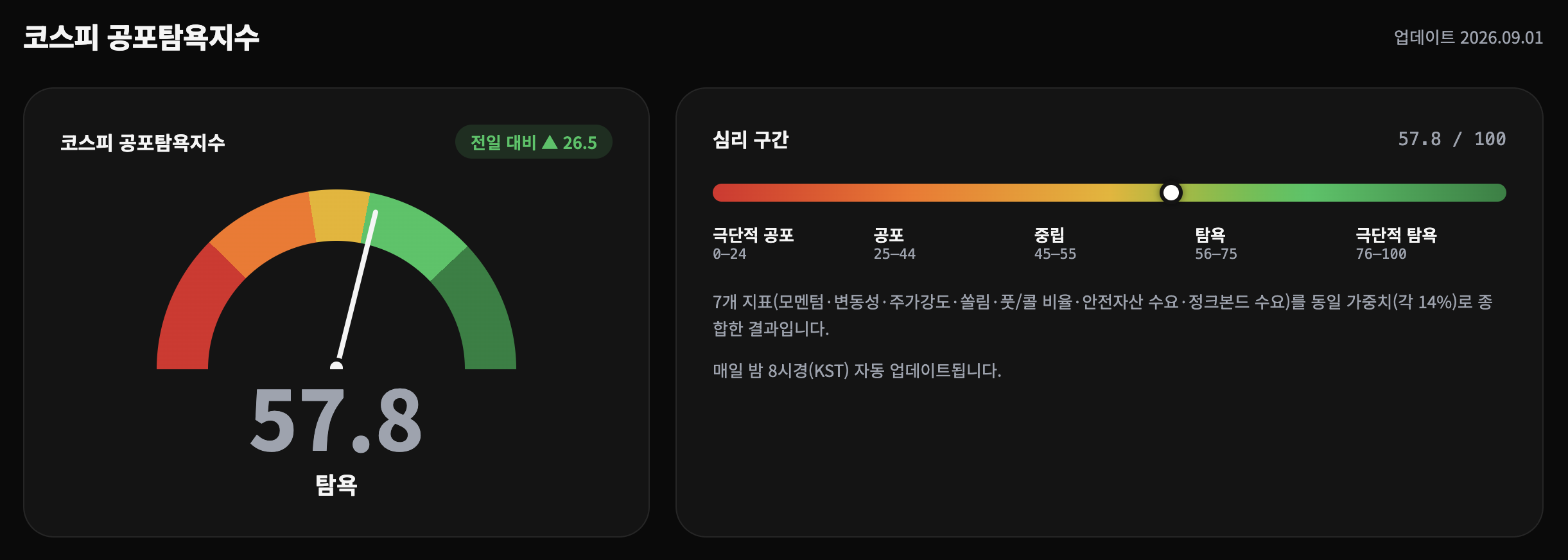
First, the Fear & Greed Index is a data-driven metric that quantifies the psychological state of stock market participants on a scale from 0 to 100. Based on data, 10Bagger provides independent indices for both the KOSPI and KOSDAQ markets.
In calculating the index, seven key indicators—market momentum, stock price volatility, stock price strength, stock concentration, put/call ratio, safe-haven demand, and junk bond demand—are equally weighted at 1/7 each. (If this sounds too complex, feel free to skip to the next section.)
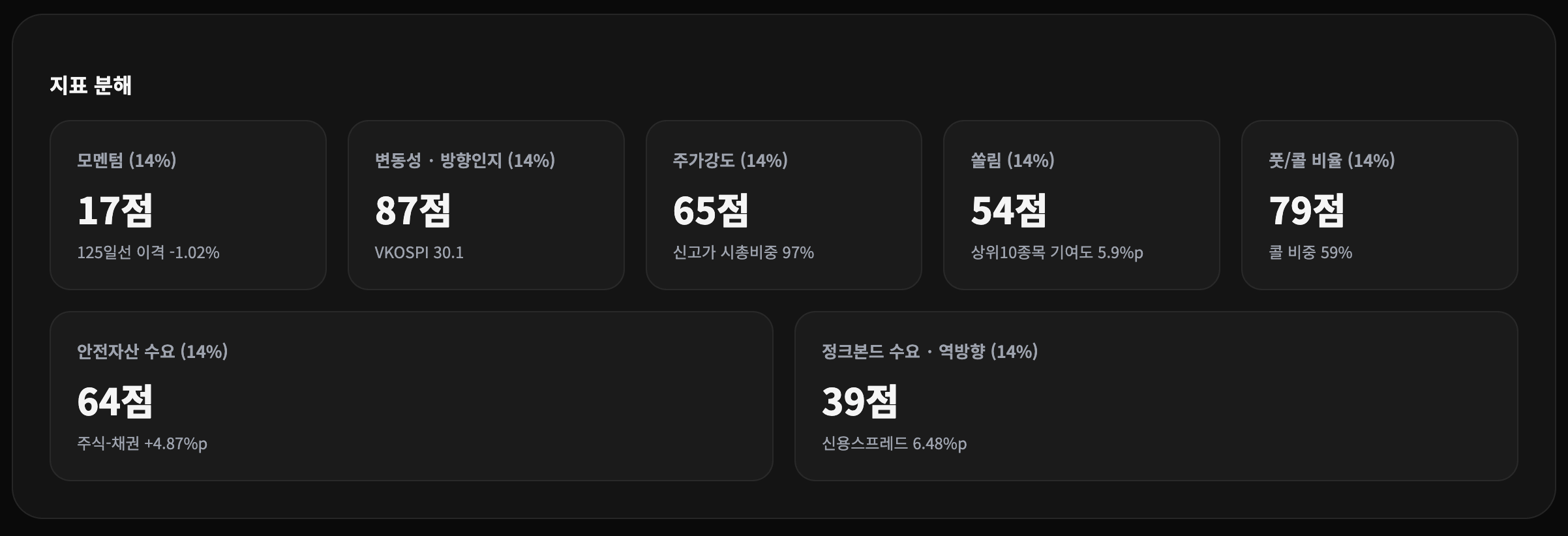
Basic Concept of the Fear & Greed Index and Its 5 Stages
The Fear & Greed Index quantifies investor sentiment into a score between 0 and 100. Based on data, it identifies whether the current market is overheated or stagnant, divided into five distinct stages:
- Extreme Fear (0–24): An oversold market state, offering an opportunity to seek a rebound after forming a bottom.
- Fear (25–44): A stage where selling pressure slows down, requiring a conservative approach.
- Neutral (45–55): A wait-and-see stage to monitor trend reversal or continuation.
- Greed (56–75): A stage where the upward trend strengthens and short-term overheating begins.
- Extreme Greed (76–100): A stage where the risk of a short-term peak increases, calling for strict risk management.
Unique Features of 10Bagger's Fear & Greed Index
The widely known CNN Fear & Greed Index reflects only the US market. 10Bagger, however, tailors the metric to the domestic Korean market by calculating independent indices for KOSPI and KOSDAQ, enabling a more precise market analysis.
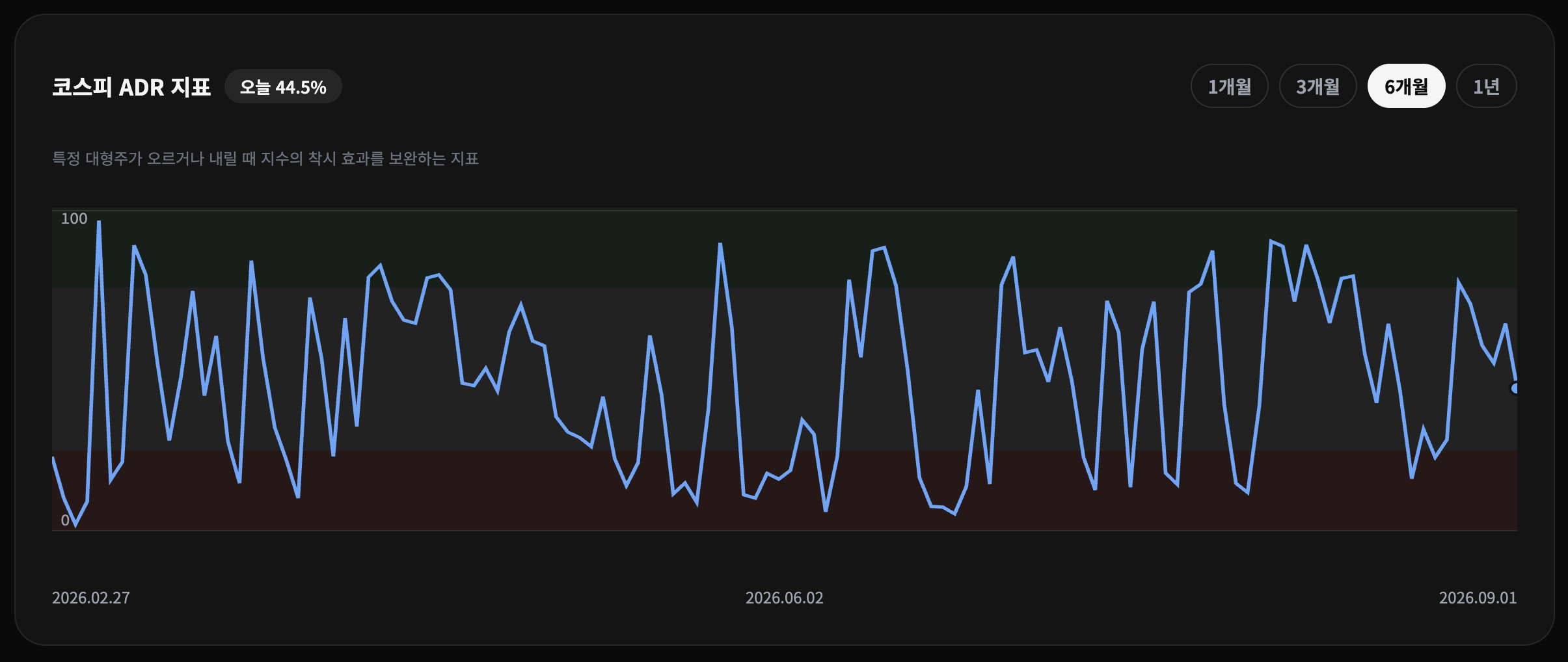
In particular, it provides the 'ADR (Advance-Decline Ratio)' as a supplementary indicator to accurately diagnose market concentration. For example, if the Fear & Greed Index enters the 'Greed' zone but the ADR is declining, it indicates a high probability of an optical illusion—where money flows into only a few large-cap stocks, driving up the index alone.
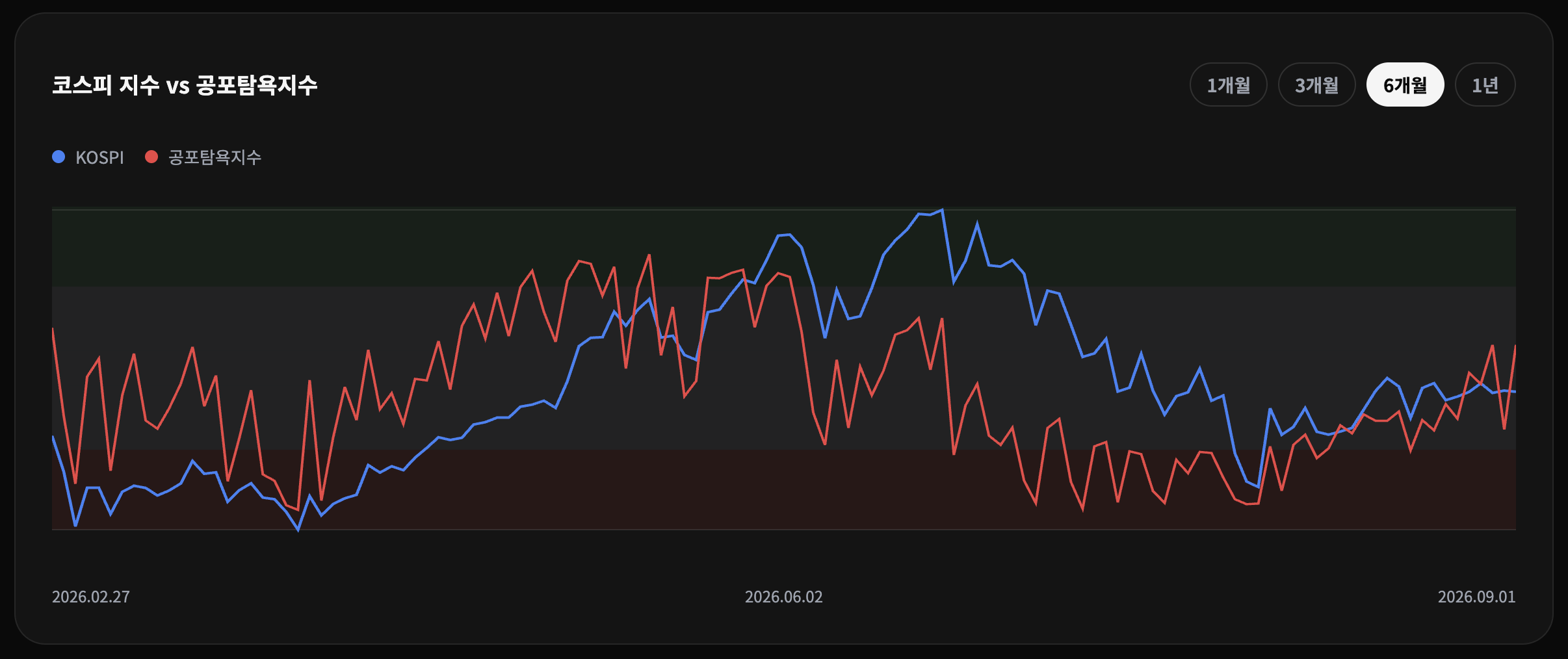
Finally, it provides visual charts comparing each market index against the Fear & Greed Index to show historical trends. By examining the flow of both the market index and the Fear & Greed Index together, you can gauge market sentiment much more easily.
2. How Should You Use It?
Using the Fear & Greed Index is simple. When the index is in the 0–24 (Extreme Fear) zone, panic selling has occurred in the market. You can approach this as an opportunity to buy blue-chip stocks at a bargain, or if you already hold them, hold on rather than selling in panic.
Conversely, in the 76–100 (Extreme Greed) zone, the risk of a correction due to overheating is high. In this stage, it is advisable to conservatively take profits to reduce exposure or refrain from making new investments.
Of course, the Fear & Greed Index is not 100% accurate. However, knowing whether the current market is in an overheated phase or a correction phase can help prevent you from trading impulsively based on market hype.
3. Conclusion
Investment decisions should be based on concrete facts and data, rather than being driven emotionally by crowd mentality. 10Bagger was created to bridge the information gap for retail investors by quantifying market sentiment based on objective data and delivering valuable investment insights.
We hope that combining 10Bagger's sentiment indicators and supply/demand data will help you build effective investment strategies and manage risk.